What Led to the Development
It all started with the question, “Can we make something just like this?”
Until now, Asahi Diamond had little experience in the food industry. To be honest, until recently, this was an area we had no particular plans to focus on. However, building on our success in developing diamond rolls for rice polishers, our perspective is now beginning to change significantly.
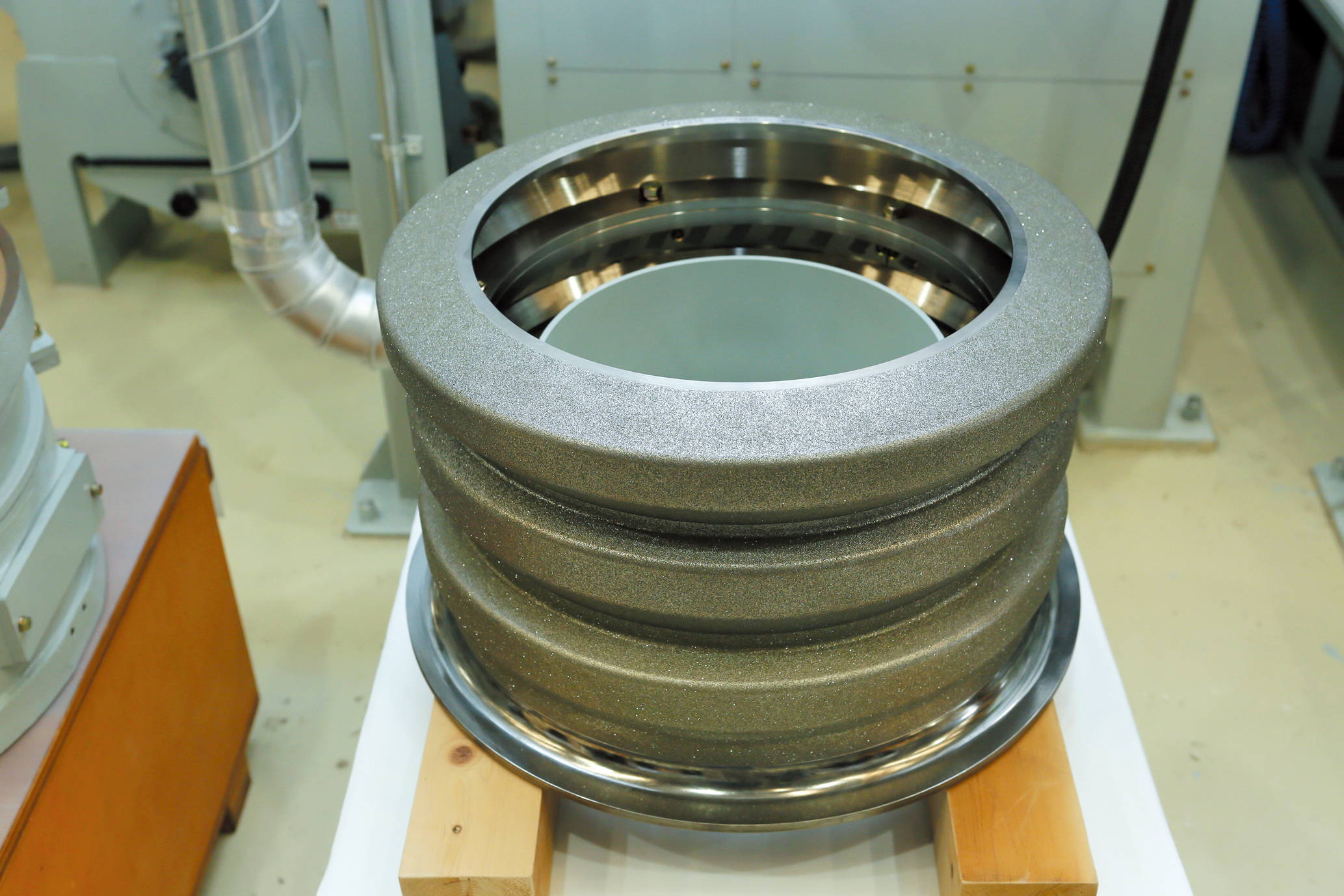
It all started in 2013 with an inquiry from a customer who manufactures rice polishers. The customer was already considering a rice polisher that used diamond rolls made by another company.However, they were dissatisfied with the quality of those rolls, which is why they turned to Asahi Diamond. The initial request was, “Can you make something exactly like this?” Asahi Diamond, confident in its technical capabilities, fulfilled this order without any issues. The finished product not only matched the performance of the existing rolls but also succeeded in delivering even sharper cutting performance. The client was satisfied, and we thought this small project had come to a successful conclusion… but little did we know, this was merely the prologue to the story.
Initiatives
Solving Two Challenges in Succession: Color Variation and Rice Bran Clogging
Everything about the first delivery could not be perfect. One of the problems was not performance, but appearance. Some of the products were unevenly colored or discolored. Although there was no performance problem, this could be a source of concern for users in the food industry. Most of the staff in charge of production handled only industrial products on a daily basis. We solved the problem by raising everyone's awareness of quality and reviewing the manufacturing process from the very beginning, gradually raising the level of perfection.
Then, the customer suddenly requested a large increase in production. In order to respond to this request, we needed to further improve the stability of quality, so we proposed that Asahi Diamond manufacture everything from the base metal to the entire production process. The base metal is the base on which diamond abrasive grains are electrodeposited. Until then, we had been using the base metal supplied by the customer, but in order to achieve higher quality, we thought it would be best to manufacture the base metal from scratch. This proposal was accepted without incident. It took some time, including the selection of a partner company, but in the end we were able to achieve both a beautiful finish and a high supply capacity at the same time.
Our relief was short-lived, however, as the next request came in from the customer. They pointed out that if the bran from the rice bran grinding in the rice polishing machine became trapped between the diamond abrasive grains, they would become clogged and lose their sharpness, resulting in a reduction in the speed of rice polishing. We solved this problem by using the special electrodeposition technology used in our other products to achieve specifications that minimize bran clogging. After repeated trial and error, we successfully achieved quality that satisfied the customer. We succeeded in greatly surpassing the existing product in both appearance and performance.
Development Results
Bringing Transformation to the Sake Brewing Industry
While conventional rice polishing machines use grinding stones, a major advantage of switching to diamond rolls is the reduced stress on the rice. Since diamond has a higher thermal conductivity than grinding stones, it effectively dissipates heat from the rice. This, in turn, prevents the rice from cracking—a condition known as “shattered rice”—and enables the production of high-quality sake rice.
Another benefit for users is reduced power consumption, made possible by the lighter weight resulting from the different structure. While maintainability is improved, the high durability of the system itself reduces the frequency of maintenance, providing long-term benefits. Furthermore, while grinding stones must be disposed of as waste once they are worn out, diamond abrasive grains can be re-electroplated onto the same base metal, thereby contributing to a reduced environmental impact.
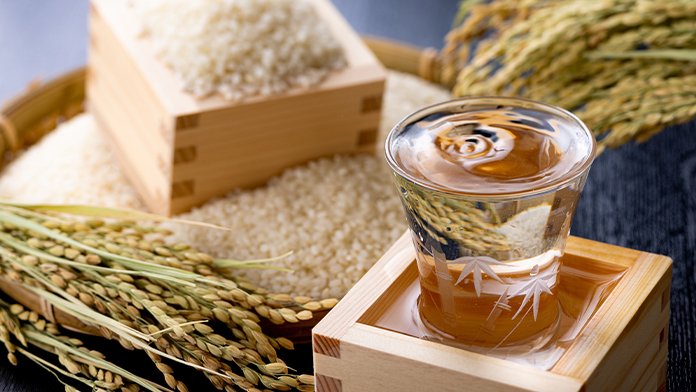
At a sake brewery that installed a rice polisher equipped with Asahi Dia’s diamond rolls, the amount of broken rice was drastically reduced to one-third of the previous level, and electricity consumption was cut by more than 30 percent. Above all, word of the high quality of the polished rice spread throughout the industry, and the brewery even began contracting to handle rice polishing for neighboring sake breweries. It can be said that Asahi Dia’s products brought about a significant transformation in the business of this single sake brewery.
World domination isn't just a dream
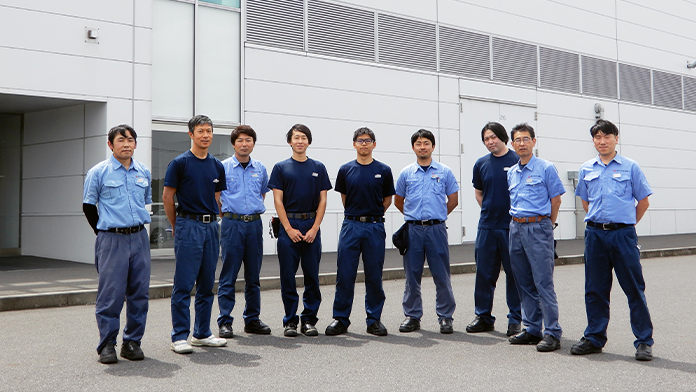
Our client has been selling compact rice polishing machines to small breweries for some time now. They have also adopted Asahi Diamond’s compact diamond rolls for these machines, and we just delivered a shipment just the other day. We understand that the client has long been considering expanding into the sale of slightly larger rice polishing machines as well, and we are, of course, committed to continuing our partnership by supplying the diamond rolls for those machines.
We believe it would be a waste to limit the rice polishing technology we’ve developed through this project to rice alone. This is because the technology can be applied to various grains, such as wheat and corn. Expansion is by no means a pipe dream—not only in Asia, where rice cultivation thrives, but also in any country or region that produces grains, meaning worldwide.
Until recently, Asahi Dia viewed the food industry as something somewhat distant. Now, however, it has transformed into an industry that is seriously considering not just expanding globally, but actually dominating the world. The day when the recognition that “Asahi Dia’s technology is at the heart of the food industry” spreads throughout the world may be closer than we think.